
The Bigger the Gantry, the Smaller the Margin for Error
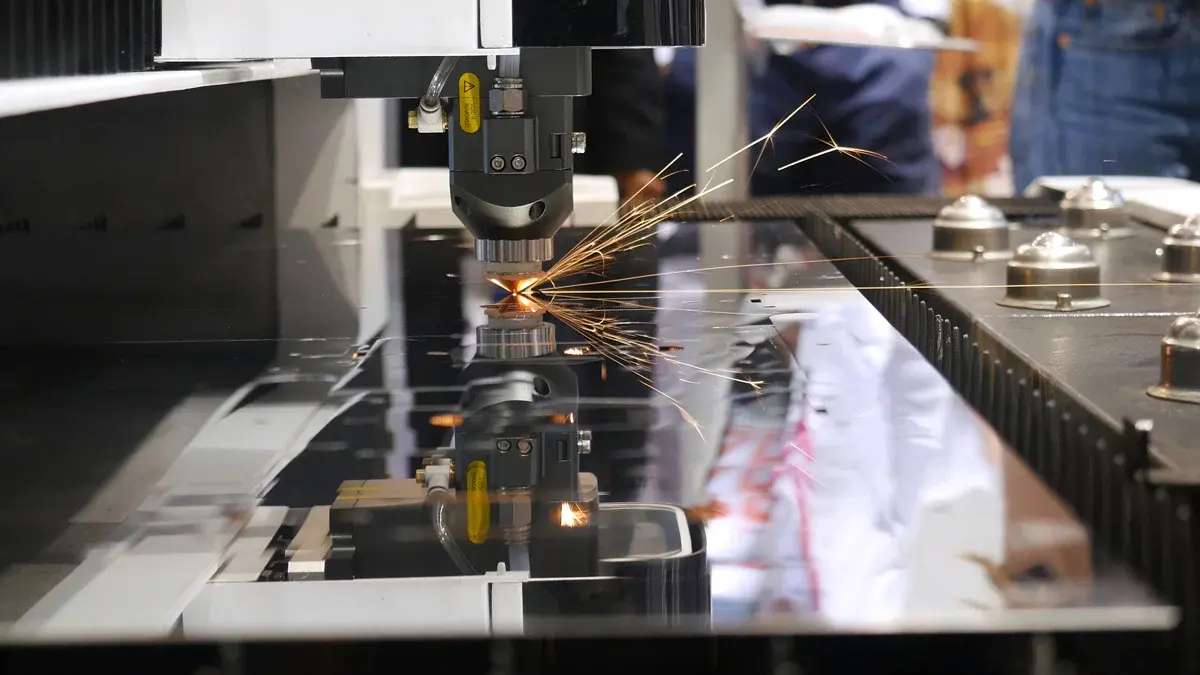
How Allient's facility, team of experts, and precision testing capabilities combine to enable customer needs in gantry motion and precision at scale.
Large-format motion systems appear deceptively straightforward. Make the structure longer and wider. Install larger motors. Lengthen encoder scales. Tune the controller. Job done.
Except it rarely is.
As travel distances increase, so too do the opportunities for tiny geometric errors to accumulate into significant process inaccuracies. Orthogonality begins to drift. Structural deflection changes dynamic behaviour. Floor vibration couples into the machine. Self-induced motion excites resonances. Synchronising the process axis with the focus axis becomes progressively more difficult as throughput expectations continue to rise.
For manufacturers building semiconductor inspection systems, laser processing platforms, precision metrology equipment, or advanced photonics tools, these are not theoretical concerns. They are everyday production challenges.
In many applications, maintaining precision over a metre of travel is considerably more difficult than achieving exceptional accuracy over a few millimetres. The challenge becomes even greater when process speed increases.
Modern semiconductor inspection tools, laser micromachining systems and automated metrology platforms require motion that is not only accurate, but perfectly synchronised. Imaging systems must remain in focus while scanning. Laser pulses must occur at precisely the correct position. Multiple axes must behave as though they are a single coordinated mechanism.
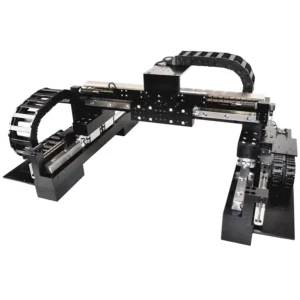
This is why Allient approaches gantry design differently. Rather than viewing the gantry as simply a larger motion stage, it is engineered as a complete precision platform. Structural orthogonality is designed into the architecture from the outset, while innovative concepts such as a Virtual Yaw Axis minimise geometric errors that become increasingly significant over long travel distances.
Mechanical design is only part of the solution.
Granite base structures provide exceptional dimensional stability, while pneumatic isolation reduces the influence of environmental vibration. Advanced trajectory optimisation enables smoother motion paths that reduce excitation of the machine itself.
At the control level, technologies such as Position Event Generation (PEG) ensure precise synchronisation between motion and process events, while advanced motion enhancement tools continually refine system performance, improving dynamic accuracy and reducing settling times during repetitive production cycles.
With a gantry design in hand, along with a stable foundation to build from and a state-of-the-art servo drive, the work is complete. Not yet.
Validation and Verification are key manufacturing components that ensure customers are getting what they need. Allient's facility, with thermally, and physically-isolated test and manufacturing rooms, enable precision measurement at the sub-micron scale. And Allient backs their test data with NIST traceability and offers the industries only Three Year Warranty.
The result is not simply a larger gantry. It is a motion platform capable of maintaining measurement-grade precision across substantial working envelopes, even in demanding manufacturing environments.
As products become larger, tolerances become tighter, and automation becomes faster, precision can no longer be considered an attribute of individual axes. It must become a characteristic of the entire machine and even more so, a part of the DNA within the people behind it.