When Precision Has to Carry More Than One Kind of Load
Photonics is often discussed as though it were one market with one set of motion requirements. In reality, it spans a remarkable range of applications, from positioning large optical assemblies and handling substantial payloads to aligning almost weightless fibers, mirrors, lenses, and photonic components.
That variation creates a difficult engineering problem.
A motion system designed for a heavy payload must generate force efficiently without introducing excessive heat, vibration, or thermal drift. A platform designed for a delicate optical component must minimize moving mass, react quickly, and settle without disturbing the alignment it is trying to create. The wrong motor architecture can compromise both.
For heavier photonics payloads, it is obvious that more force is needed, and many options exits. The key for a successful design, however, lies in the efficiency of realizing the required force. XY stages utilizing high motor constant options provide more force for a given thermal penalty, helping the system maintain throughput without allowing internally generated heat to undermine optical stability. At the other end of the scale, compact, low-mass motors reduce inertia and improve responsiveness for fiber alignment, lens positioning, beam steering, and other applications where every unnecessary gram works against dynamic performance.
The linear motor technology used in Allient’s stages features coil construction specifically designed to maximize thermal efficiency and combined with rare earth, high powered magnets, delivers motor constants that are 20 to 30% higher per volume than the competition.
But motor selection is only one part of the challenge.
Modern photonics tools increasingly require XY sample motion, Z-axis focus adjustment, galvo beam steering, and image or process triggering to operate as a single coordinated system. A perfectly accurate stage can still produce poor results if focus correction arrives late, if the laser fires between encoder positions, or if galvo movement is not synchronized with the physical location of the sample.
This is where Position Event Generation from within servo drive becomes invaluable. By triggering cameras, lasers, or galvo systems directly from encoder position, rather than through software timing, motion and process events can be synchronised with far greater determinism.
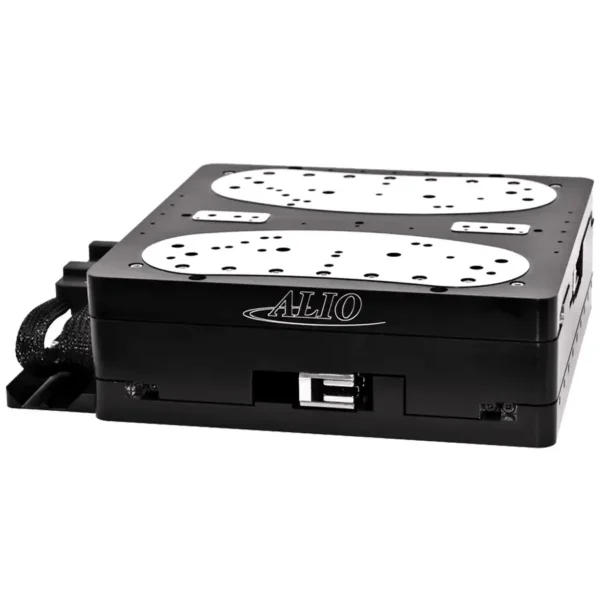
The mechanical foundation matters just as much. The monolithic XY architecture within Allient’s stages provides the stiffness and orthogonality required to preserve optical alignment across travel, while granite bases and integrated frames help isolate the process from floor vibration and self-induced motion. Complete-system tuning, verification, and validation then ensure that the stage, motor, focus axis, structure, and controller perform as one platform rather than as a collection of individually impressive components. Products like Precision Granite-Based Motion pair configurable XY and Z stages with custom granites and frames, making a complete motion system available for turn-key machine builders and OEMs.
Precise motion that remains stable, synchronized, and application-ready whether the payload is substantial or almost weightless is the real requirement in photonics. At Allient, our stages are engineered around that full-system reality.