
Home > Solutions Center > Whitepapers >
An Engineering Guide to Motors for Drone Systems
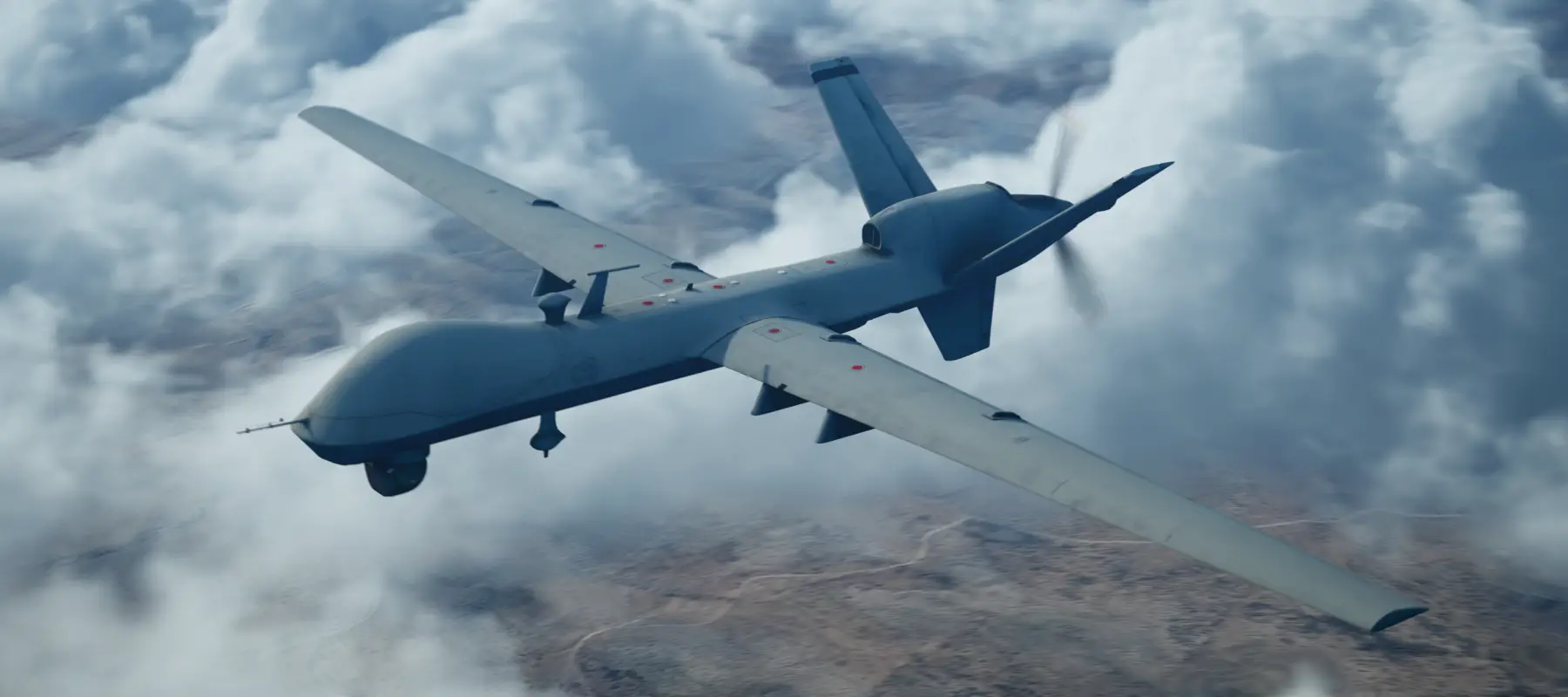
This engineering guide explains motor technologies used in drone systems and how to select the right motor for your application.
INTRODUCTION TO MOTORS FOR DRONE SYSTEMS
Drones have progressed rapidly from experimental platforms into mission-critical systems used across a range of industries. As airframes, sensors, and autonomy software advance, the demands placed on electromechanical subsystems have increased significantly. Motors sit at the center of this evolution, directly influencing payload capability, endurance, controllability, and overall system reliability.
This whitepaper is intended for engineers involved in the design and selection of motors for drone applications. It reflects engineering insight informed by Allient Inc.’s experience developing motor solutions for UAV platforms and other demanding aerospace and defense applications.
GROWTH IN DRONE APPLICATIONS
While this whitepaper focuses primarily on defense and security drone platforms, it is useful to briefly consider the broader drone ecosystem. Civil, commercial, and industrial applications have played a significant role in accelerating innovation across airframes, propulsion, electronics, and autonomy, with many of these advances later adopted in defense and security systems.
Today’s drone platforms operate in increasingly complex environments and support a wide range of missions. Defense and security applications continue to drive substantial investment, including intelligence, surveillance, reconnaissance, logistics, and counter-UAS operations. In parallel, civil and industrial deployments in areas such as infrastructure inspection, environmental monitoring, agriculture, and emergency response continue to mature and scale.
In defense and security applications specifically, operational requirements place greater emphasis on reliability, consistency, and controlled supply chains. Regulatory frameworks such as the U.S. National Defense Authorization Act (NDAA), along with similar policies in Europe, are influencing procurement strategies and increasing demand for compliant, traceable components. As a result, motor selection is increasingly guided by considerations of performance repeatability, long-term availability, and mission assurance.
WHERE MOTORS ARE USED IN DRONES
Motors are used throughout a drone system, serving both propulsion and precision motion functions.
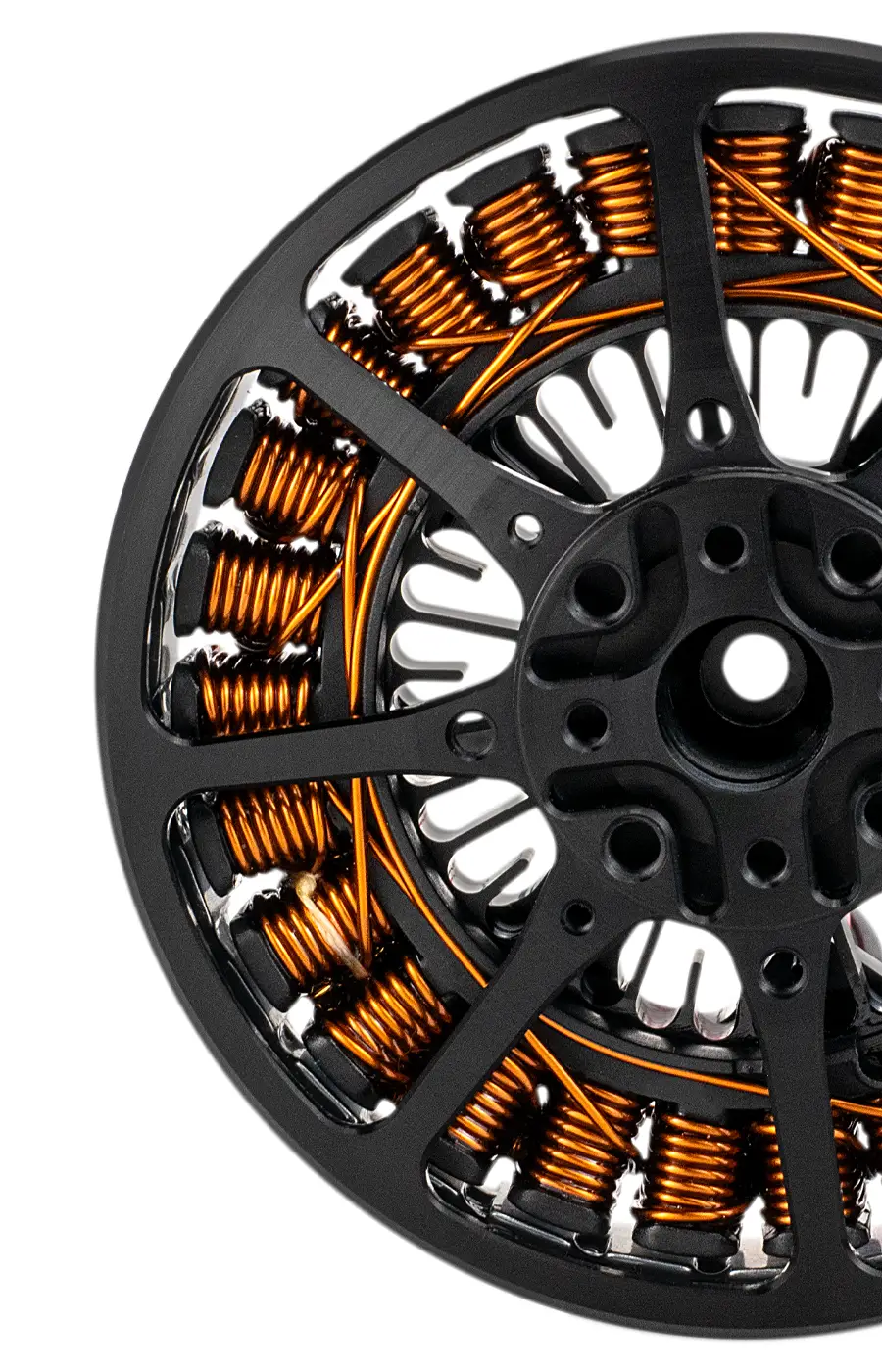
In propulsion systems, motors generate thrust for lift, hovering, climb, and forward flight. Multirotor platforms typically rely on dedicated lift motors, while fixed-wing and hybrid VTOL designs may incorporate separate motors optimized for cruise efficiency. Some platforms use tilting or re-orienting motor assemblies to transition between vertical and horizontal flight, placing additional mechanical and control demands on the motor design.
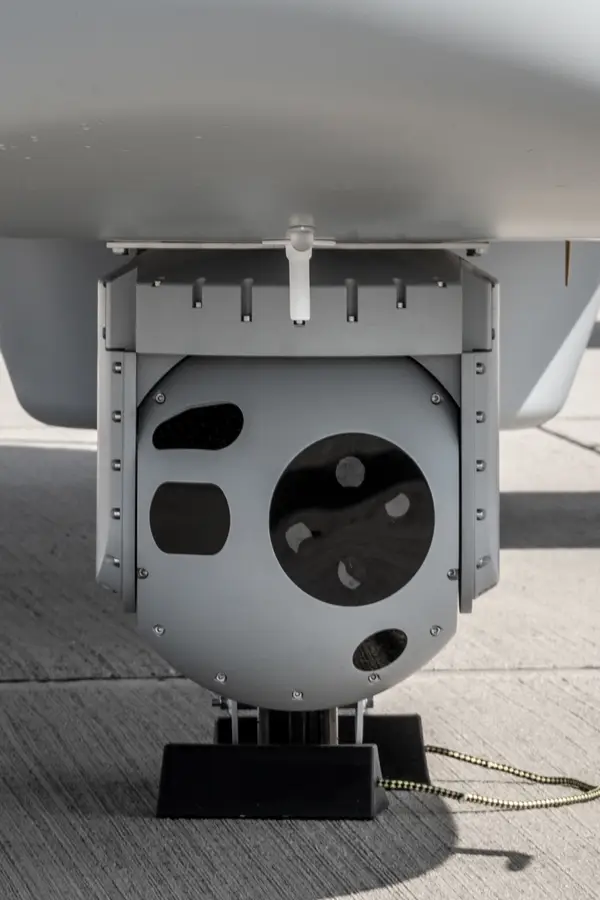
Beyond propulsion, motors play a critical role in gimbals and payload positioning systems. Cameras, radar, LiDAR, and other sensors must be stabilized and accurately positioned, often under dynamic flight conditions. These gimbal motors require smooth torque output, low cogging, rapid acceleration, and precise control. Additional motors may also be used for control surfaces, landing gear, or mission-specific mechanisms.
WHY MOTOR TECHNOLOGY IS IMPORTANT
Motor technology has a direct and measurable impact on drone performance. Thrust-to-weight ratio determines payload capacity and climb performance, while efficiency strongly influences flight time and range. Thermal behavior is equally critical. Unlike traditional industrial motors, drone motors are designed to operate with continuous airflow generated by the propeller and forward motion of the aircraft.
This airflow allows motors to deliver significantly higher power density than enclosed or stationary designs, but it also complicates specification and comparison. A motor rated for high power under airflow conditions may overheat rapidly if operated without sufficient cooling. Engineers must therefore understand not only electrical and mechanical ratings, but also the thermal assumptions behind them.
TYPES OF MOTORS USED IN DRONES
Most drone propulsion systems use brushless DC (BLDC) or permanent-magnet synchronous motors due to their high efficiency, controllability, and power density.
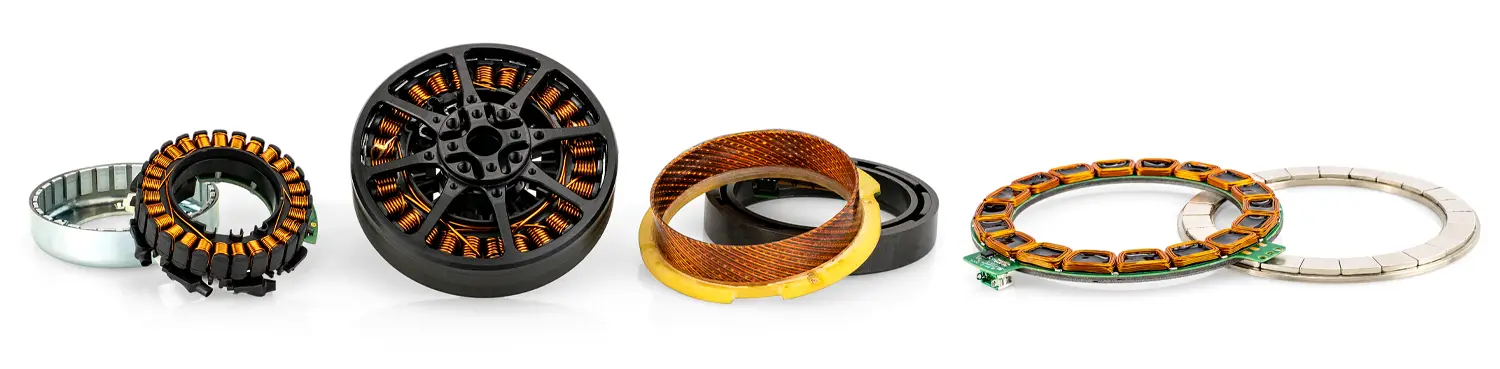
Outer-rotor motors dominate propulsion applications. In this topology, the rotor surrounds a stationary stator, allowing the propeller to mount directly to the rotating outer shell. This configuration delivers high torque at relatively low speeds and simplifies mechanical integration. Although outer-rotor designs have higher inertia than inner-rotor motors, this is typically acceptable because the propeller itself dominates system inertia.
Inner-rotor motors are more common in gimbals and auxiliary motion systems where fast dynamic response and lower inertia are important. These motors are often used in frameless configurations, allowing direct integration into existing bearing and mechanical structures.
Axial flux motors are an emerging option in drone systems, particularly for gimbals and space-constrained applications. Their large diameter and short axial length enable high torque density and compact packaging, making them well suited to low-profile, high-performance designs.
IMPORTANT PERFORMANCE PARAMETERS
Selecting a motor for a drone requires a shift in mindset compared to traditional industrial applications. For propulsion systems, thrust output is often more meaningful than torque alone. Engineers are primarily concerned with how much thrust the motor-propeller combination can produce relative to its mass, as the motor must lift both the payload and itself.
Efficiency is another critical parameter, particularly for endurance and long-range missions. Higher efficiency reduces power consumption, extending flight time and reducing thermal stress. KV rating, which relates motor speed to applied voltage, must be carefully matched to propeller size and mission profile. Bearing life, vibration behavior, and mechanical robustness also play important roles, especially in higher-end and longer-duration platforms.
KEY ENGINEERING CHALLENGES
THERMAL DESIGN
Thermal design is one of the primary engineering challenges in drone motors. To fully exploit airflow cooling, motor structures must be designed to expose heat-generating components to moving air. This often requires different mechanical packaging and material choices compared to enclosed industrial motors.
WEIGHT MINIMIZATION
Weight minimization is another dominant concern. In many drone applications, designers may accept operating conditions that would be avoided in other industries, such as driving magnetic materials closer to saturation. While this introduces non-linear behavior, it can be justified when the motor is optimized to perform a specific task extremely well at minimum mass.
RELIABILITY
Reliability expectations also differ from traditional industrial systems. Many drone motors are designed for operational lifetimes measured in hundreds or thousands of hours rather than decades. Understanding these trade-offs is essential when balancing performance, durability, and system-level risk.
HOW TO CHOOSE THE RIGHT MOTOR
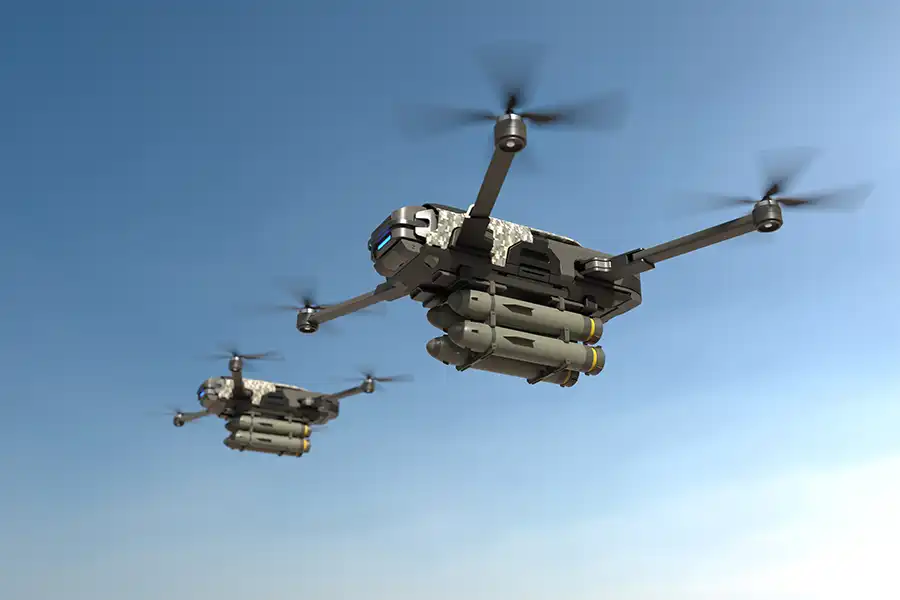
Motor selection should begin with a clear understanding of the mission profile. Defense and security drones vary widely in size, range, payload, and operational duration, and no single motor architecture suits every platform. Heavy-lift drones prioritize torque density and thrust capability, while long-range or endurance platforms emphasize efficiency and sustained operation under partial load.
Engineers should evaluate motor data in the context of airflow conditions, propeller matching, and real operating points rather than relying solely on nominal ratings. Thrust curves, thermal behavior under forced convection, and efficiency at the expected operating speed are often more relevant than peak values.
PRACTICAL MOTOR SELECTION CHECKLIST
- What is the primary mission profile (hover-dominant, endurance, high-speed, heavy lift)?
- What thrust-to-weight ratio is required, including motor self-weight?
- How much continuous airflow will be available for motor cooling during operation?
- Is efficiency at cruise or hover more critical than peak power?
- What propeller size and speed range will be used?
- Are environmental factors such as dust, moisture, vibration, or shock exposure significant?
- What operational lifetime is required?
- Are there regulatory or supply-chain compliance requirements?
- Is performance consistency across production units critical?
EXAMPLE USE CASES
ENDURANCE-FOCUSED DRONES
Typically use motors optimized for forward-flight efficiency. These designs often feature smaller diameters and longer axial lengths, paired with propellers suited for sustained cruise, enabling flight times measured in hours.
LIFT-ORIENTED DRONES
Rely on large-diameter, short-axial motors that maximize airflow and thrust. These platforms are commonly used for vertical lift, hovering missions, and payload delivery where high thrust is required for shorter durations.
GIMBAL SYSTEMS
Use low-profile, large-diameter motors to achieve smooth, precise motion. Frameless and axial-flux designs are particularly effective, allowing tight integration with existing mechanical structures and high positioning accuracy.
TRENDS
Several trends are shaping the future of drone motor technology, particularly in defense and security applications. Supply-chain assurance and regulatory compliance are driving increased demand for traceable components. At the same time, system designers continue to push for higher power density, improved thermal utilization, and tighter mechanical integration.
Emerging mission profiles, including counter-UAS systems, long-endurance surveillance platforms, and hybrid VTOL aircraft, are introducing new requirements around continuous operation, reliability, and integration with advanced sensors and communications.
SUMMARY
Motors are a foundational element of drone performance and reliability, particularly in defense and security platforms where mission success depends on predictable, repeatable operation. Selecting the right motor requires an understanding of airflow-based thermal behavior, thrust-to-weight trade-offs, mission duration, and environmental exposure.
By combining decades of motor engineering experience with a focus on modern UAV requirements, Allient Inc. is positioned to support engineers developing the next generation of high-performance, reliable drone systems.
REFERENCES
- Department of Defense, Unmanned Systems Integrated Roadmap.
- C. Amici, F. Ceresoli, M. Pasetti, et al., Review of Propulsion System Design Strategies for Unmanned Aerial Vehicles, Applied Sciences, MDPI.
- B. Zhang, Overview of Propulsion Systems for Unmanned Aerial Vehicles, Energies.
- R. Austin, Unmanned Aircraft Systems: UAVs Design, Development and Deployment, Wiley.
- N. Ismail, Electric Propulsion and Hybrid Energy Systems for Solar-Powered UAVs, Drones (MDPI).
NEED SUPPORT SELECTING THE RIGHT TYPE OF MOTOR?
Contact Allient for support with motor selection for your application.