
What is a Torque Motor?
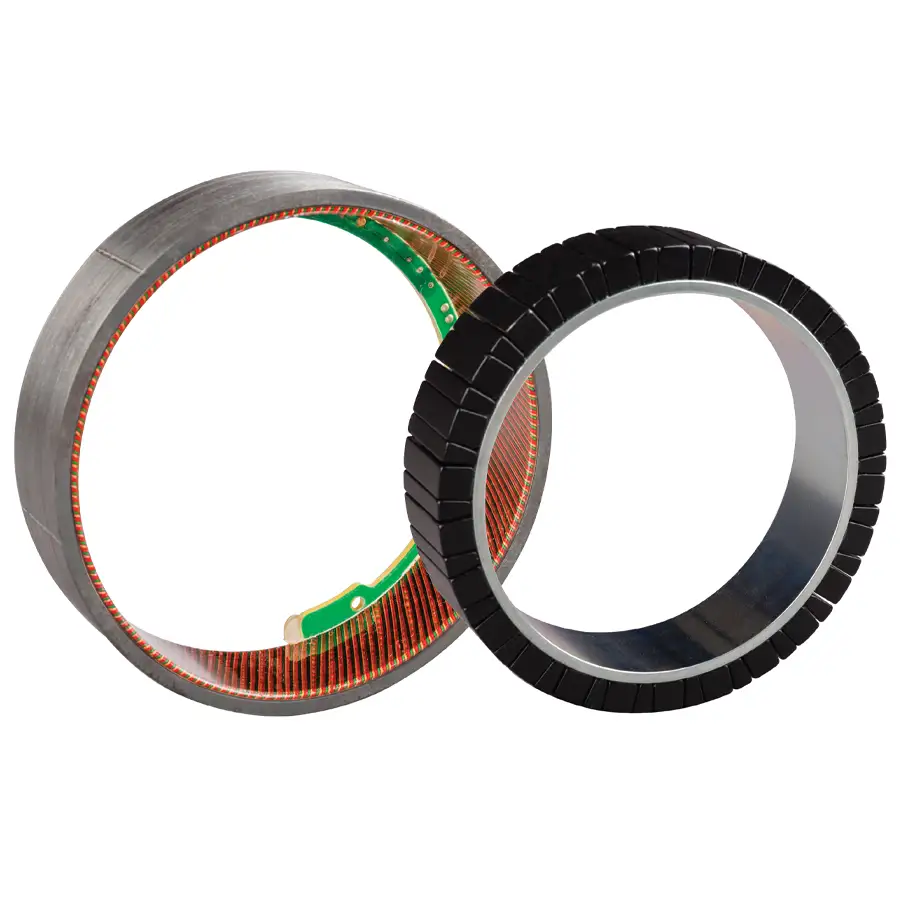
LS Series Torque Motor
Torque motor is a term that has been created to describe a motor that will be used mainly for torque control in a precision system. Many of these systems move in very small increments and limited angles of rotation and the motor could be holding position against a varying load. That doesn’t mean that torque motors cannot run at high speeds, in fact many of them do. Torque motors are also typically frameless kits consisting of a rotor and a stator that the user integrates into other mechanical systems.
The frameless torque motor is essentially the electromagnetic guts of a traditional motor without a shaft, bearings, or housing. Below is a good example, with key features such as a low axial profile, a large internal through hole, and a thin radial cross section.
Torque Motor Applications
Torque motor applications include gimbals, rotary turrets, indexers, precision rotary stages, and any application where movement is precise and torque control is the dominant application requirement (as opposed to speed control). Many of these systems are also direct drive applications where the smoothness of torque production with angle is critical. In some applications, like robotic joints, torque motors are used in combination with a high-ratio zero backlash gear to create high torque in a very low axial profile. The motor to the left is a slotless motor with zero cogging torque and optimized for direct drive applications.
Torque Motors for Camera Gimbals
Most motors, even well-designed frameless torque motors, still have torque ripple when operating at near-zero speed. Magnetic design choices have been made in the iron, copper, and magnets to get a reasonable compromise between thermally limited torque output, motor constant, and mechanical size. Unfortunately, this compromise results in cogging and non-linear torque output with current.
The best design for optimal torque control is a motor that has very sinusoidal torque production with angle and zero cogging. Sinusoidal torque production works in harmony with sinusoidal current waveforms from the motor driver to create a smooth rotating torque vector. Slotless motors like the picture above are the best at producing both sinusoidal torque output with angle and zero cogging. All other technologies tend to have higher harmonic content, cogging, and saturation at higher current levels. All these limitations impact smoothness and create torque ripple.

Brushless DC Torque Motor
To explain modern-day Direct Drive applications and the motors configured for them, it is important to understand a little bit about motor history. In the late 1800’s Thomas Edison and George Westinghouse were battling it out to decide which electrical grid would prevail, DC (Edison) or AC (Westinghouse). It was a heated battle and set the course of history by lighting up the world while simultaneously killing the battery-powered electric car.
While the original application for the electrical grid was lighting, electric motors were close behind and needed for pumping, and moving things in factories like machine tools and transfer lines, not to mention HVAC and household appliances. DC was good for motors but not for light bulbs and power transmission. Through a wild political and industrial battle called the “War of Currents” AC power won out over DC and proliferated because it was inherently safer and easier through run transmission lines over far distances. Nicola Tesla, a big proponent of AC power, developed several motors optimized for running directly from the AC electric power grid, the most popular became the modern-day AC Induction motor. More than 50% of all generated power is consumed by electric motors today, most of them are AC Induction motors.
Background Information on Motors
DC motors are more commonly identified with variable torque or controlled torque applications. Current flowing in a DC motor directly relates to torque output. The motor does not need to be moving for this phenomenon to happen. Because of the evolution of motors and their uses, starting with speed as the dominant factor, original DC motors took on a form factor similar to AC Induction motors and more easily adapted to variable speed requirements because torque was proportional to current, and speed was proportional to voltage.
Short axial length and large diameter motors were created for lower speed low acceleration direct drive applications. Diameter was used to get higher torque, because motor torque output increases with diameter faster than it increases with length. Higher pole counts allowed for thinner lamination thickness by localizing magnetic field paths. Higher pole count motors generally create more torque in the same package. Motor inertia also increased, but direct drive high torque applications typically do not require high acceleration.
The ability to control torque output without rotation enabled many new applications where a motor could be used as a torque device and did not have to rotate. Tensioning, winding, and haptic torque feedback were all possible with the DC motor. This was not possible with an AC Induction motor without significant excess heating, and the controls that were not available until almost the end of the 20th century.
During the computer revolution, electronic controls with transistors and microcontrollers could accurately control current in multiple phases. Brushes and commutators were removed from DC motors and replaced with position sensors and transistors. Brushless DC motors, or synchronous motors, were enabled and became widely available. Suddenly, new form factors became available for the DC (now brushless) motor.