
Types of Motors Used in Drones
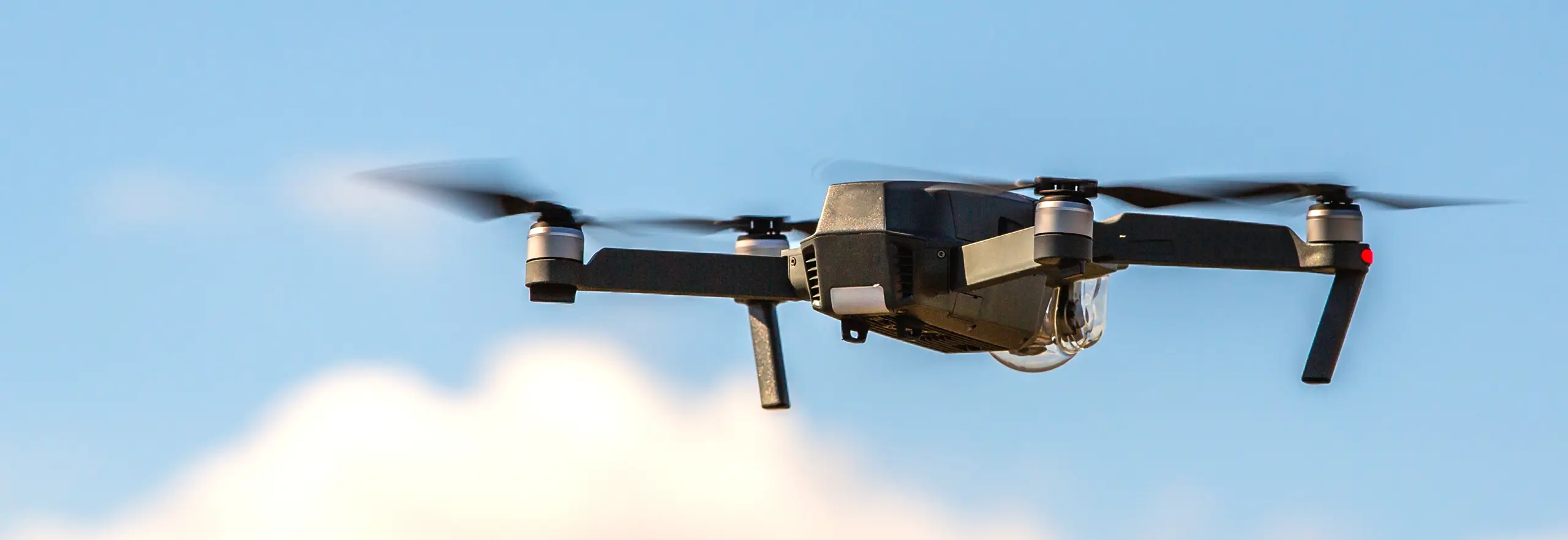
In a previous blog, we highlighted the main applications for motors in drones. In this article, we examine the types of motors used in drone systems.
For a detailed overview, you can download our engineering guide to motors for drone systems here.
Most drone propulsion systems use brushless DC (BLDC) or permanent-magnet synchronous motors (PMSMs) due to their performance characteristics and suitability for electronically controlled flight systems. Both motor types rely on electronic commutation and permanent magnets to generate torque, eliminating mechanical brushes and reducing wear compared to brushed motor designs.
These motor technologies are commonly selected for:
- High efficiency
- Precise controllability
- High power density
- Reduced mechanical wear due to brushless construction
Electronic speed controllers regulate motor performance by controlling phase currents, enabling accurate adjustment of speed and torque across varying flight conditions. In propulsion applications, coordinated motor control supports stable thrust generation and controlled maneuvering, particularly in multirotor platforms where multiple motors operate simultaneously.

Outer-Rotor Motors in Propulsion Applications
Outer-rotor motors dominate propulsion applications in many multirotor and VTOL platforms. In this topology, the rotor surrounds a stationary stator, allowing the propeller to mount directly to the rotating outer housing. This configuration simplifies mechanical integration and reduces the need for additional shaft extensions or couplings.
The larger effective rotor diameter enables higher torque production at relatively low rotational speeds, which aligns well with propeller-driven propulsion systems that prioritize efficient thrust generation. Although outer-rotor motors generally exhibit higher inertia than inner-rotor designs, this is typically acceptable in propulsion applications, where the propeller itself contributes significantly to total system inertia and steady thrust output is the primary requirement.
Inner-Rotor Motors for Gimbals and Auxiliary Systems
Inner-rotor motors are more common in gimbals and auxiliary motion systems where fast dynamic response and lower inertia are important. With the rotor positioned inside the stator, the rotating mass is typically smaller, supporting quicker acceleration and deceleration.
This characteristic is beneficial in stabilization applications, where motors must respond rapidly to maintain sensor orientation during aircraft movement. Inner-rotor motors are often used in frameless configurations, allowing integration into existing bearing structures and mechanical housings. This approach supports compact packaging and precise alignment within motion subsystems.
Axial Flux Motors in Emerging Applications
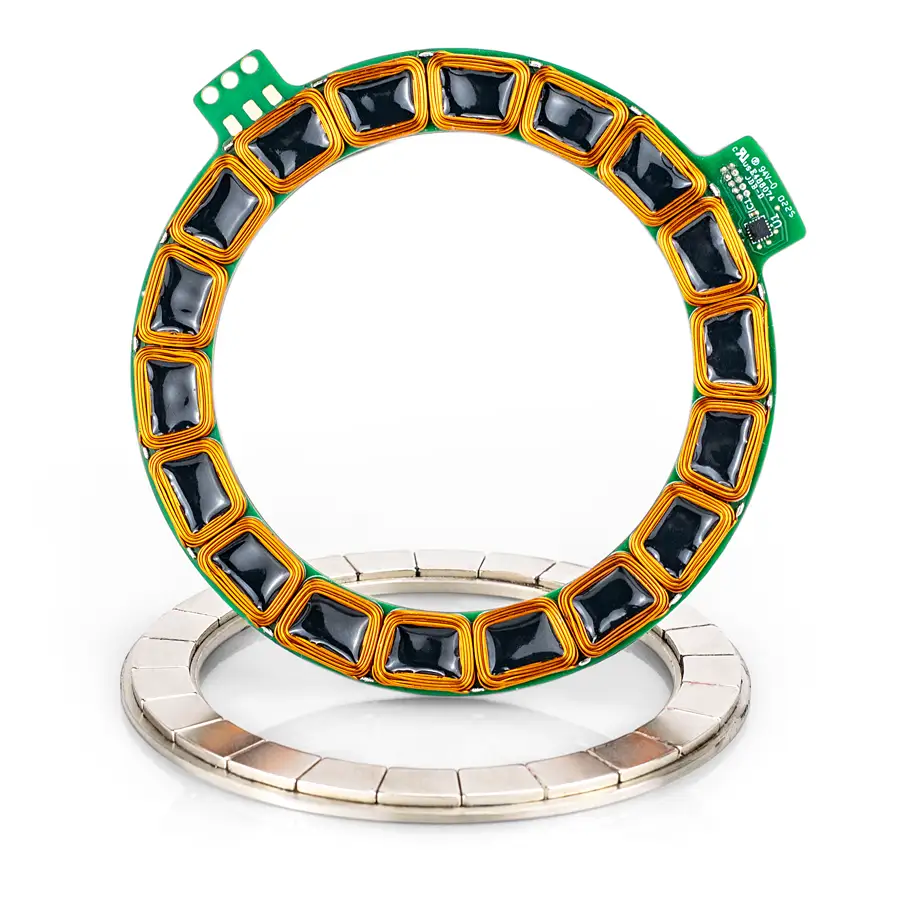
Axial flux motors are an emerging option in certain drone systems, particularly for gimbals and space-constrained designs. Unlike radial flux machines, axial flux motors feature a magnetic path oriented parallel to the shaft, resulting in a geometry characterized by large diameter and short axial length.
This configuration can provide high torque density within a compact axial form factor, making it suitable for low-profile or tightly packaged assemblies. While not yet widely adopted in mainstream propulsion systems, axial flux motors are gaining attention in applications where packaging efficiency and torque density are key considerations.
If you are developing a drone platform and require a more detailed technical overview, download our engineering guide to motors for drone systems or contact our team to discuss your requirements.