
Evolution of Precision: From Stewart Platforms to Hybrid Hexapods
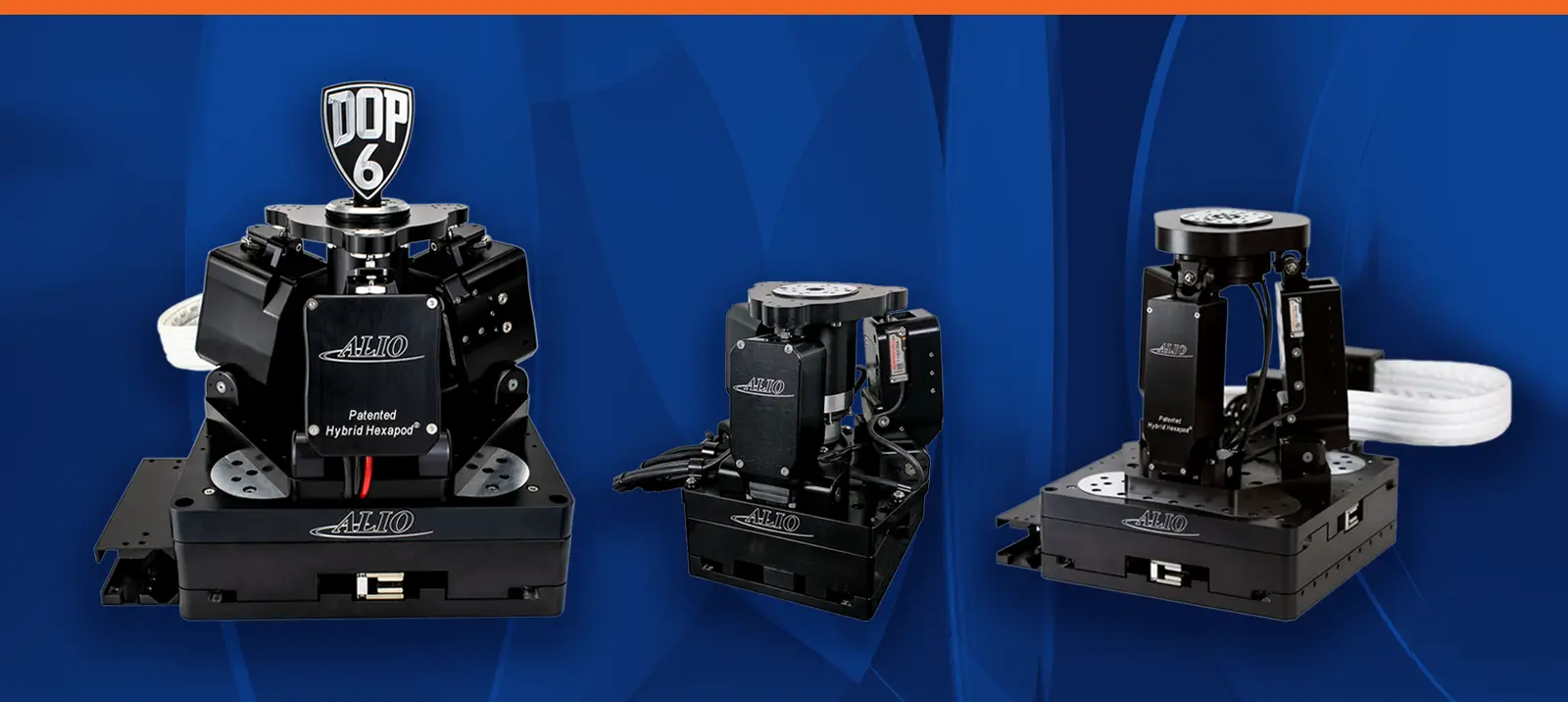
While the traditional Stewart platform has long been the standard for achieving six degrees of freedom (6-DOF) in applications ranging from flight simulation to precision manufacturing, its parallel kinematic design often suffers from limited yaw rotation, accumulated motion errors, and a lack of passive stiffness. The Hybrid Hexapod® represents the next generation of this technology, overcoming these mechanical bottlenecks by combining a parallel tripod structure with a monolithic serial kinematic XY stage. This evolved design delivers sub-micron-level accuracy, a work envelope up to 5x larger than conventional hexapods, and superior motion fidelity for today’s most advanced industrial requirements.
What are the Benefits of Six Degrees of Actuation?
Six axis of motion is valued for several key reasons:
- Multi-Axis Capability: Provides true 6-DOF control by allowing simultaneous translation along the X, Y, and Z axes and rotation about pitch, yaw, and roll.
- Complex Profile Execution: Enables the performance of intricate, coordinated motion profiles necessary for advanced applications like robotic surgery simulation, satellite tracking, and dimensional contact metrology.
- Application Versatility: Offers a flexible platform capable of adapting to diverse industrial needs, from heavy-duty vehicle testing to high-precision optical alignment.
What is a Stewart Platform?
A Stewart platform, also known as a hexapod, is a motion system that provides movement in six degrees of freedom (6-DOF): translation along X, Y, and Z axes, and rotation about pitch, yaw, and roll. It consists of a top platform connected to a fixed base by six independently actuated legs arranged in a parallel kinematic configuration.
What are the Limitations of Stewart Platforms?
Despite their strengths, conventional Stewart platforms have several drawbacks:
- Accumulated Motion Errors: Each leg and joint contributes to platform positioning error.
- Limited Yaw Rotation: Typically restricted to small angular ranges, far short of continuous 360-degree motion.
- Reduced Accuracy in Non-Vertical Motions: Motions in X, Y, pitch, and roll are less precise because all legs are performing different motions simultaneously.
- Lack of Passive Stiffness: When unpowered, the platform often has no inherent rigidity, potentially collapsing in multiple degrees of freedom.
- Flatness and Straightness Degradation: Even well-designed systems may only achieve tens of microns of flatness or straightness, unacceptable for high-end nanometer-level work.


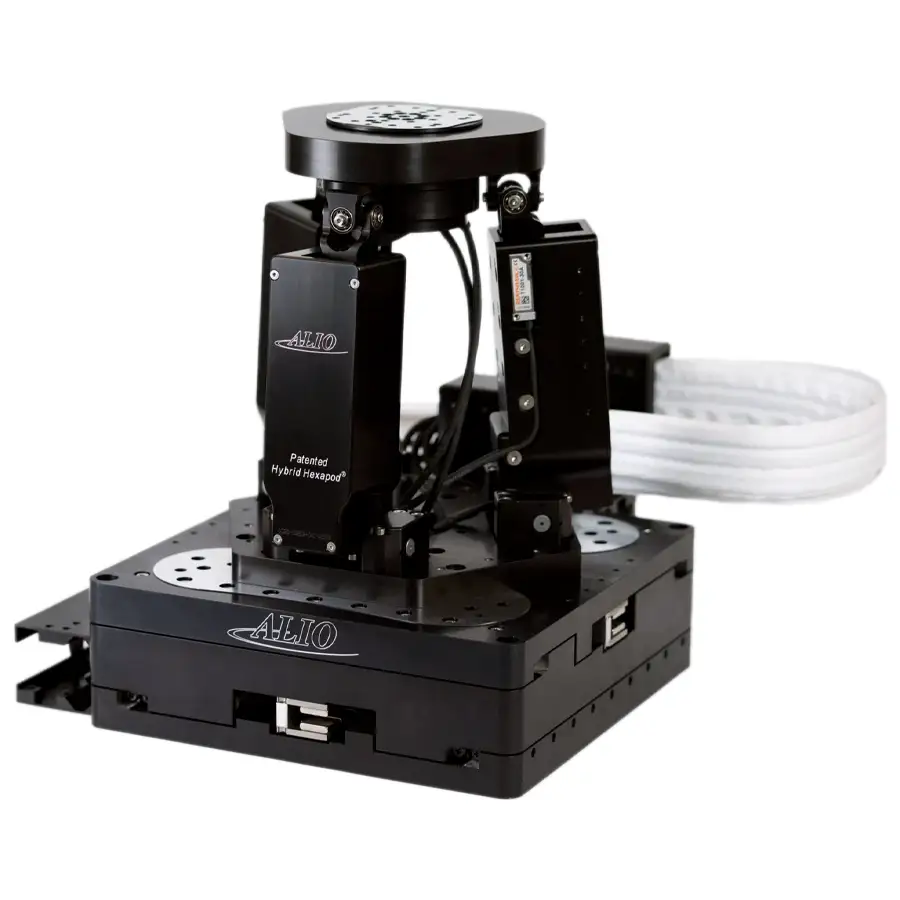
Hybrid Hexapod® vs Stewart Platform
The Hybrid Hexapod® from Allient's ALIO Industries is the next generation of Stewart platform technology, retaining the core benefit of six degrees of freedom while solving its biggest limitations.
Instead of using six identical actuators to control all motion, the Hybrid Hexapod® uses a parallel tripod kinematic structure for Z-axis and angular movements (pitch/roll), combined with a monolithic serial kinematic XY stage for planar motion, and a dedicated rotary axis for continuous 360° yaw.
This design delivers:
- Greater Stiffness: Both powered and unpowered, improving safety and stability.
- Larger Usable Work Envelope: Up to 10x the workspace of conventional hexapods.
- Improved Motion Fidelity: Better flatness and straightness of motion for precision applications.
- Direct Control of Primary Motion Axes: Simplifies programming and improves motion profiling.
- Nanometer-Level Accuracy: Suitable for the most demanding optical, semiconductor, and precision manufacturing applications.
The result is a smarter, more capable evolution of the Stewart platform, one that delivers the precision, scalability, and repeatability required for today’s most advanced industries.