
What Really Determines Drone Performance Starts Inside the Motor
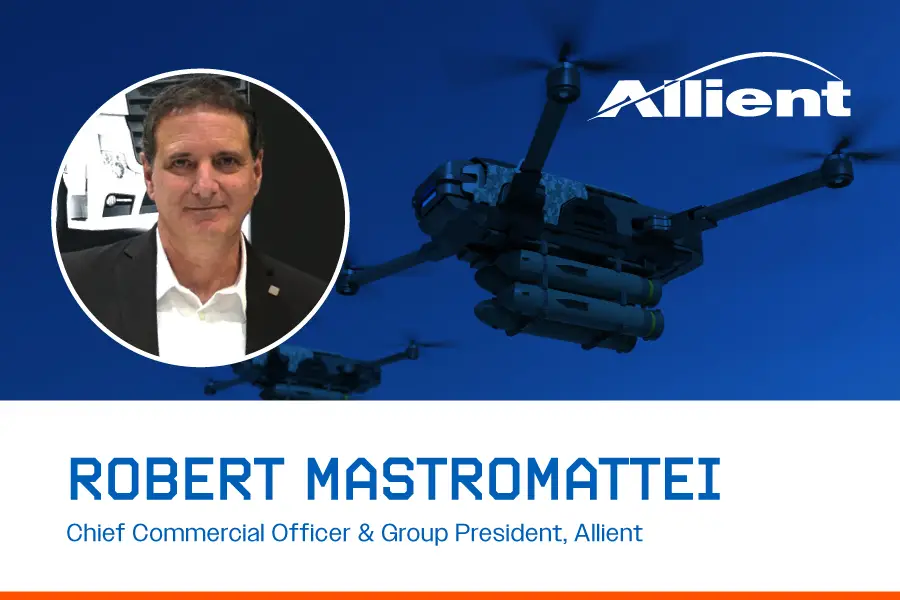
The global drone market is growing rapidly across defense, aerospace, security, and industrial sectors. As platforms evolve and mission demands increase, the motor has become a defining factor in endurance, control, and reliability. In this interview, Robert Mastromattei, Chief Commercial Officer at Allient Inc., shares expert insight into the role of motor technology in enabling next-generation drone performance.
1. Drone platforms are evolving quickly. From your perspective, what is driving the biggest change in motor requirements today?
Motors are no longer being selected as supporting components. They are increasingly viewed as core system elements that directly influence mission success.
As autonomy, sensing capability, and payload complexity increase, motors play a central role in determining endurance, controllability, and overall reliability. Engineers are looking beyond peak output and focusing more on how motors behave across real operating conditions, including temperature variation, altitude, and duty cycle.
There is also a shift in how drones are being used. Platforms are flying more frequently, often in regulated or mission critical environments. That raises expectations around consistency and predictability, not just performance.
2. Thermal behavior is often underestimated in drone systems. Why is it such a critical factor?
Drone motors operate in a thermal environment that is fundamentally different from most industrial applications.
They rely heavily on airflow generated by the propeller and forward motion of the aircraft. This enables very high power density, but it also means thermal performance changes significantly depending on flight mode. Hover, climb, cruise, and descent all create different cooling conditions.
If those differences are not fully understood, a motor can operate much closer to its limits than expected. Over time, that impacts efficiency, magnet stability, bearing life, and insulation durability. Thermal behavior ultimately defines how hard and how long a motor can be pushed reliably.
3. How should engineers think differently about motor selection for drones compared to traditional industrial applications?
The biggest change is moving away from nominal ratings and datasheet comparisons.
For propulsion systems, thrust and thrust to weight ratio are often more meaningful than torque alone. Engineers need to understand how the motor and propeller interact, where the system operates most of the time, and how efficiency behaves at those points.
Weight constraints also reshape design decisions. In drone systems, it is common to operate materials closer to their limits in order to reduce mass. That approach can be very effective, but only when the motor is designed and validated specifically for that operating regime.
4. Mission profile plays a major role in motor choice. How do requirements differ across platforms?
Mission profile drives nearly every aspect of motor selection.
Heavy lift and hover dominant platforms prioritize torque density, thermal margin, and mechanical robustness. These systems must deliver reliable thrust under sustained load, often with limited tolerance for degradation.
Endurance focused platforms place far greater emphasis on efficiency at cruise. Even small improvements in efficiency can translate directly into longer flight times or extended range.
Gimbals and payload positioning systems have a very different set of priorities. Smooth torque, low cogging, fast response, and tight mechanical integration are essential, and these requirements often drive the use of frameless or low-profile motor architectures.
5. Integration is becoming a major theme in drone systems. How is that changing expectations around motors?
Motors are increasingly being considered as part of a broader subsystem rather than standalone components.
OEMs are looking for propulsion and motion solutions that integrate electronics, communications, diagnostics, and mechanical interfaces. This reduces development complexity and helps improve overall system reliability.
Integration also enables better health monitoring. As drones move into higher utilization roles, understanding how components are behaving in real time becomes critical for maintenance planning and mission assurance.
6. Defense and security applications add pressure around compliance and supply chain control. How does that influence motor design and production?
In defense and security applications, consistency becomes just as important as performance.
Programs need motors that behave the same way across production runs, with controlled changes and long-term availability. That influences everything from material selection to manufacturing processes, qualification methods, and documentation.
It is not enough to build a high-performance motor once. The real challenge is producing it repeatedly, with predictable behavior, and supporting it over the full life of the platform.
7. Allient Inc. has a long history in the defense and aerospace ecosystem. How does that translate into value for drone OEMs today?
It starts with scale and continuity.
Allient manufactures millions of motors every year, and that production capability underpins long-term relationships with some of the largest drone OEMs in the world. For those customers, we are not a short-term component supplier. We are a long-term partner supporting programs that move from early development through production, scale-up, and sustained deployment.
That matters in the drone market, where platforms evolve, volumes change, and performance requirements tighten over time. OEMs need confidence that their motor partner can support design iteration, production ramp, and long-term availability without introducing risk.
Our role is to help customers design propulsion and motion solutions that work not just in the prototype phase, but consistently and predictably across the full life of the platform.
8. Looking ahead, what will define good motor technology for drones over the next decade?
Reliability, integration, and confidence will define success.
Motors will need to support higher utilization and longer duty cycles, often in more demanding environments. Diagnostics and health monitoring will become standard expectations rather than optional features.
Ultimately, the platforms that succeed will be built around predictable, repeatable performance, not just impressive peak specifications.
Working On A Drone Project?
For everything you need to select the right motor for your drone application download our whitepaper: An Engineering Guide to Motors for Drone Systems, or contact our Solutions Center.